The Team Meeting
Active bystandership, everyday courage, and the moments that shape workplace culture


The meeting
Dr A is a foundation doctor. She is reaching the end of her post, during which she worked hard to complete a quality improvement project (QIP). She’s been invited to present her QIP during the departmental meeting, at which her peers and the whole team will be present. You join the meeting just as Dr A is due to present.
Dr A is introduced by the Consultant chairing the meeting (Dr B), who enthusiastically refers to her as “The beautiful Dr A!”. Dr A gives a nervous laugh and looks very uncomfortable. She regains composure and goes ahead, presenting her work expertly and fielding questions from the team.
As Dr A draws the questions to a close, Dr B declares, “See, she is as clever as she is attractive!”
Again, Dr A looks uncomfortable, quickly sits down and makes an unusually hasty exit when the meeting ends.
Scenarios similar to this, in which inappropriate comments or behaviour cause an individual to feel uncomfortable, potentially unsafe, and almost certainly singled out, are not uncommon. Many of us will have witnessed similar scenarios in our working lives.
Many of us have our own stories to tell
I’ve written, and posted here on Substack, two personal stories of my own experiences of inappropriate behaviour. One in the context of a power imbalance (The Fabergé Egg Moment) and another of gender inequality and poor behaviour playing out in an interview scenario (Do You Like Shopping at Harvey Nichols?). These are not one-off or isolated incidents.
The national picture – what does the NHS Staff Survey tell us about how often NHS staff experience unwanted behaviours?
The NHS Staff Survey is one of the largest workforce surveys in the world and asks questions about the experiences of NHS staff working in their organisations. In 2025, 766,285 staff returned their survey responses, which equates to a 49% response rate, with the majority of responses from acute or community trusts.
Within the domain “We are safe and healthy”, 17% of staff experienced at least one incident of harassment, bullying or abuse from other colleagues in the past 12 months, and 3.51% had been the target of unwanted behaviour of a sexual nature in the workplace in the past 12 months, with this figure rising to 7.79% for medical and dental staff.
In “The Team Meeting” scenario you are placed directly into the meeting as a bystander. You could be another foundation doctor, a friend or peer of Dr A. You could be a member of nursing staff, working alongside both Dr A and Dr B in the clinical setting. Or you could be a fellow Consultant and peer of Dr B.
How do you think Dr A felt during the meeting? How did you feel when these comments were made? What would you do?
Do you have a responsibility to do something?
What is an Active Bystander?
An active bystander is usually described as “someone who witnesses a problematic, inappropriate, or potentially harmful situation and chooses to step in to help, challenge the behaviour, or de-escalate the event, rather than remaining a passive observer”. The term active bystander describes the person; “active bystander” is a noun. It is the name given to a person in that circumstance.
What is Active Bystandership?
By adding the suffix “-ship” to a word, this adds additional meaning, e.g. the position, qualities and skills of being an active bystander.
“Active bystandership is simply the power of third parties, through their action, to reduce harm.” Graham Goulden, lead trainer with the US Active Bystander in Law Enforcement (ABLE) Programme
Goulden describes how some view the term “Active Bystander” as an oxymoron - the pairing of the term “bystander” (a person in a neutral or indifferent state, who is not actively involved) with “active”. He describes how the passivity within the term can lead to feelings of shame, as there is no acknowledgement of the real and often complex difficulties of speaking up. Goulden states that, on the contrary, active bystandership is not passive and that it involves decision-making, taking responsibility and becoming an agent of change.
In order to enact active bystandership there is a requirement of an individual, firstly, to have an awareness of what behaviour is or isn’t appropriate, to be able to question and think about what is happening, how individuals are feeling and why they are behaving that way, and to then make a decision about how to intervene or offer support. This process of observation, thinking, decision-making and moral judgement is encompassed within the term “Active Bystandership”.
Goulden reminds us that:
“The dictionary portrays bystanders as people who ‘do not take part’ — as if they’re merely observers without power. But everyone who witnesses a situation has agency. They have two choices: do nothing or do something.”
Why is Active Bystandership important?
It is well recognised that by intervening and reinforcing that certain behaviours will not be tolerated, it is possible to shift the cultural dial away from unwanted behaviours and towards respectful and compassionate teamship. Intervention can also lead to prevention of escalation of harmful behaviours.
And there are consequences of remaining silent or doing nothing.
“In the end, we will remember not the words of our enemies, but the silence of our friends.” Martin Luther King
“If you are neutral in situations of injustice, you have chosen the side of the oppressor.” Archbishop Desmond Tutu
How to be an Active Bystander
Active bystandership is a key skill that can be both taught and learnt. It is something that doesn’t always feel natural to many people. Whilst you may recognise poor behaviour, making the decision to take action can be hard. For this reason, I am sharing a useful resource/infographic and some helpful tips. By familiarising yourself with available strategies and rehearsing responses, it can become easier to intervene when needed.
The ABC approach for initial assessment of the situation
Firstly, I recommend this helpful ABC acronym from the University of Cambridge “Breaking the Silence” campaign:
Assess for safety: If you see someone in trouble, ask yourself if you can help safely in any way. Remember, your personal safety is a priority — never put yourself at risk.
Be in a group: It’s safer to call out behaviour or intervene in a group. If this is not an option, report it to others who can act.
Care for the victim: Talk to the person who you think may need help. Ask them if they are OK.
Having established it is safe to intervene, as a witness to “The Team Meeting” scenario, what then are the approaches you could take? Below, the “Four D’s” infographic covers how you can respond either in the moment or afterwards, either alone or with others, and any of these approaches may be appropriate.
The Four D’s
The infographic below gives some helpful tips on strategies for active bystandership.
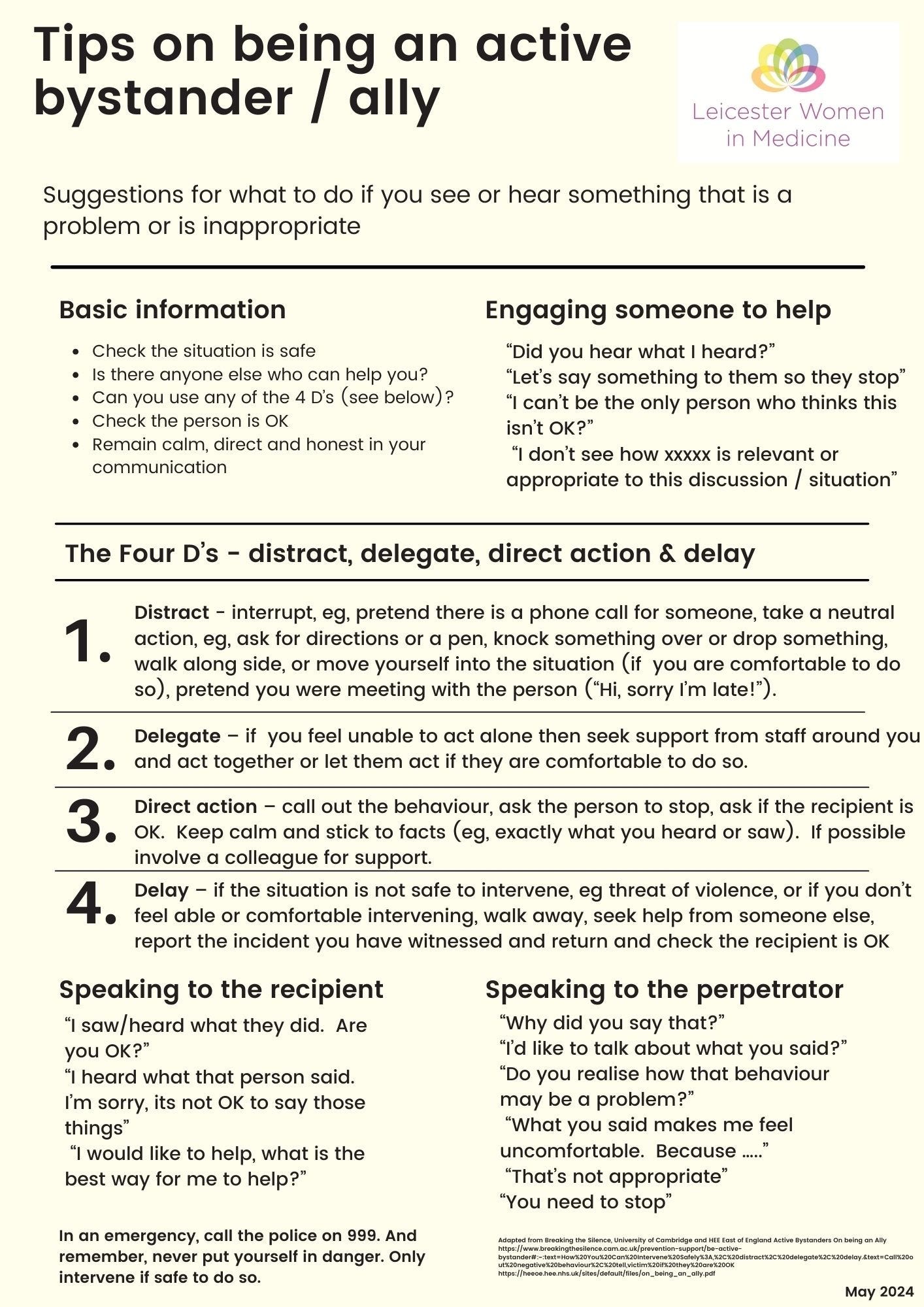
Note: A fifth “D” is often suggested — “Document”. Make a contemporaneous record of what you saw and what you did. Keep to the facts. It is recommended that you share this document with the person targeted, allow them to decide what they wish to do with the record, and maintain their confidence.
The perceived challenges of Active Bystandership
Returning to Graham Goulden’s writing - he describes how active bystandership comfortably covers the range of bystander acts alluded to in the infographic above: delaying action (if too unsafe to intervene), distracting or delegating/helping indirectly, and direct action.
He reassures us that active bystandership does not require heroics or confrontation, and that sometimes indirect interventions are the shrewdest. He describes how people “overestimate how dramatic intervention needs to be and underestimate how ordinary, human-scale it often is”, and that this can lead to hesitancy in intervening.
The risk of comeback or consequence can weigh more heavily than the benefits of “doing the right thing”, but ultimately we need to keep circling back to the fact that by leaving poor behaviours unchallenged - by ignoring them - we are reinforcing them.
To return to “The Team Meeting” and what you would do
There is no “right” or “wrong” strategy, and your decision-making will depend on multiple variables. However, if you believe in the value and importance of active bystandership, then the following final tips will help you find the right response for the scenario — right response for both Dr A and you.
If you have any doubt about a situation, check in on Dr A and ask her how she is feeling.
Ensure that Dr A’s safety is the priority.
Give control to Dr A; listen (without judgement) and maintain confidentiality.
Use the strategy which feels safest for both yourself and Dr A — remember direct, in-the-moment action is not always required; indirect action can be as effective.
Rehearse the phrases you feel most comfortable using - if you have rehearsed a phrase, it is often easier to use when you need to.
Consider delegation or collective action - did a group of you witness the same behaviour, did you all feel uncomfortable, and can you take action together?
Remain compassionate, both to Dr A and yourself.
Know how to signpost Dr A to local support, policies and escalation processes, should she need them.
Remember that active bystandership can be applied to any scenarios, be they inappropriate gendered behaviour, sexual harassment, racism, ageism, ableism, bullying or discrimination, harassment or harmful behaviour of any sort.
The most important thing to remember is that active bystandership rarely feels straightforward. There is often uncertainty, discomfort, and “back of the mind” considerations about possible consequences. We won’t get it right every time but culture can only be changed by the decisions we make in these moments. Small actions matter as does our willingness to act. Collectively we can contribute to creating a workplace culture in which staff feel seen, safe to thrive and respected.
https://www.nhsstaffsurveys.com/results/national-results/
https://grahamgoulden.com/2025/10/06/why-getting-the-terminology-matters/
https://www.breakingthesilence.cam.ac.uk/prevention-support/be-active-bystander
Note: The scenario described in this article is fictional. If you witness or experience unwanted behaviour, please seek support from a trusted colleague, peer or friend. Refer to Trust/local reporting platforms, Trust/local policies and local/national charitable organisations for support and guidance. If in immediate danger, call the Trust security team and/or the police.
Having phrases in your back pocket for any challenging situation is a really good strategy for life overall. Often we berate ourselves later for not responding in real time, however creating a plan will go a long way for next time around.
Thank you for the reminder that keeping quiet in these all too common situations isn’t ok.